

Goosey Goosey Gander


Lyrics
Goosey goosey gander,Whither shall I wander?Upstairs and downstairsAnd in my lady's chamber.There I met an old manWho wouldn't say his prayers,So I took him by his left legAnd threw him down the stairs.
History and Meaning
A wandering goose, a lady's chamber, and an old man thrown down the stairs for refusing to say his prayers. "Goosey Goosey Gander" is harsher than most nursery rhymes, and it has attracted one of the most confidently repeated dark-origin stories in English folklore: that it encodes the hunting of Catholic priests. The story has a problem. The lines it explains were not in the rhyme.
Origins
The rhyme was first printed in 1784, in Gammer Gurton's Garland, or The Nursery Parnassus, a chapbook of 79 rhymes edited by the literary antiquary Joseph Ritson. It is catalogued as Roud 6488.
Here is what that 1784 text actually says:
Goose-a goose-a gander, Where shall I wander? Up stairs and down stairs, In my lady's chamber; There you'll find a cup of sack And a race of ginger.
No old man. No prayers. No stairs. The earliest known version of "Goosey Goosey Gander" is a cheerful six-line jingle that ends with a drink and a piece of ginger, and the same is true of most early printings.
The four lines everyone now quotes, the ones about the old man who would not say his prayers and the leg and the fall, were grafted on later, apparently amalgamated with the goose rhyme sometime in the early nineteenth century. They almost certainly began life as a separate scrap of verse. Nursery rhymes collide and merge like this constantly; two short fragments with a compatible rhythm get sung together often enough that the join stops being audible.
Was Goosey Goosey Gander about Catholic priest holes?
Almost certainly not, and the dates are what rule it out.
The theory runs like this: the goose is a Puritan soldier, "my lady's chamber" is a priest hole, the old man who will not say his prayers is a Catholic priest refusing the English-language Protestant liturgy, and throwing him downstairs is the violence done to clergy found during searches. It is a tidy reading, and it is repeated across the internet as settled fact.
The trouble is that every element it explains sits in the four lines that were not part of the rhyme in 1784. The persecutions being invoked belong to the sixteenth and seventeenth centuries; Oliver Cromwell died in 1658. The verse those lines supposedly encode appears in the record more than 150 years after the events, and grafted onto a rhyme whose original ending was about fortified wine.
The theory's provenance is also thinner than its popularity suggests. Wikipedia's article traces the priest-hole and Cromwell readings to the amateur historian Chris Roberts and flags them as needing a better source. Iona and Peter Opie, whose Oxford Dictionary of Nursery Rhymes is the standard scholarly reference for this material, do not endorse it.
This is the normal pattern for nursery-rhyme dark origins rather than an exception. "Ring a Ring o' Roses" is not about the plague either, and for the same reason: the historical reading was invented long after the rhyme, and the earliest texts do not support it.
What does "a cup of sack and a race of ginger" mean?
These are the rhyme's real original ending, and both are period words worth knowing.
Sack was a strong fortified white wine imported from Spain and the Canary Islands, hugely popular in England from the sixteenth century onward. It is Falstaff's drink throughout Shakespeare.
A race of ginger means a root of ginger. "Race" here has nothing to do with running or with peoples; it comes via Old French from the Latin for root, the same source as "radish." Shakespeare uses exactly this phrase in Henry IV, Part 1, where a carrier is transporting "two razes of ginger."
So the 1784 rhyme sends the goose wandering through the house and rewards it in the mistress's chamber with a cup of wine and a spice root. Both were expensive imported luxuries, which is the joke: the good stuff is kept in my lady's room.
Who is the old man in the rhyme?
Nobody has ever identified him, and there is no reason to think he was anyone. He arrives with the later four-line fragment and comes without context.
One detail often offered as evidence deserves a note. The claim is that "left leg" points to "left-footer," a slang term for a Catholic used in parts of Ireland and Scotland, supposedly from Irish Catholic labourers digging with the left foot. That etymology is itself disputed folk etymology, and the slang is not documented early enough to explain a verse of this age. It is a coincidence pressed into service, not a clue.
What is a priest hole?
Priest holes were real, and they are genuinely interesting even though they are not the source of this rhyme. During the anti-Catholic penal era, wealthy Catholic families built concealed compartments into their houses behind panelling, under floors, and inside chimney stacks, so that visiting priests could hide during searches. The finest surviving examples, at houses like Harvington Hall in Worcestershire, are attributed to the Jesuit lay brother Nicholas Owen, who built them for years before being captured and tortured to death in 1606.
That history stands on its own evidence. It just has no documented connection to a goose rhyme first printed in 1784.
Meaning
Read plainly, the original is a wandering rhyme. A gander asks where it should go and roams the house, upstairs, downstairs, into the private chamber, which is exactly what a farmyard goose that gets indoors does. Geese were kept close to the house, they are territorial and noisy, and the comedy of one loose in the bedrooms needs no explanation.
The later version is stranger and that is much of its appeal. A child gets an abrupt piece of cruelty with no build-up and no moral, which is a large part of why this rhyme is remembered when gentler ones are forgotten.
When was Goosey Goosey Gander first published?
1784, in Gammer Gurton's Garland, or The Nursery Parnassus, edited by Joseph Ritson and printed in London. That printing has six lines and ends with the cup of sack and the race of ginger. The familiar eight-line version, with the old man and the stairs, is a nineteenth-century composite and is the one printed at the top of this page, because it is the version sung today.
Music Video
If the player is unavailable, watch this video on YouTube.
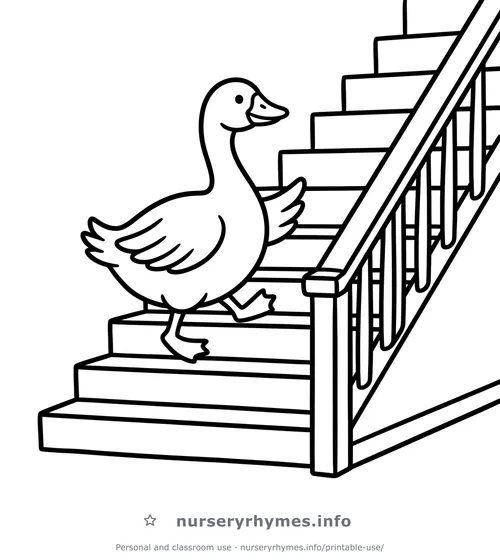
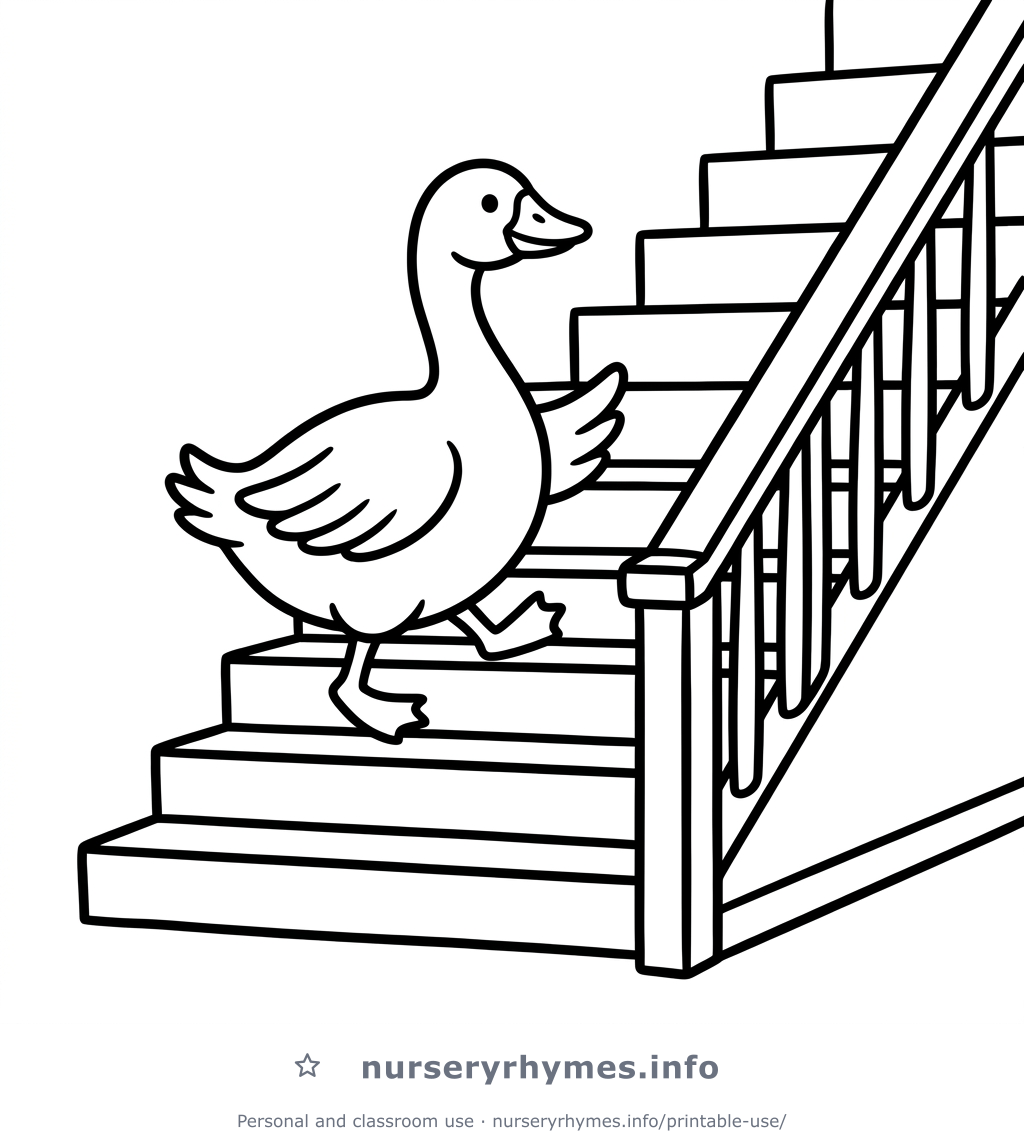
Free Printable Coloring Page
Print this Goosey Goosey Gander coloring sheet for free and let little ones bring it to life with crayons or pencils.
Full-resolution PNG · Fits the paper size selected in your print dialog · Personal and classroom use
Related Nursery Rhymes




Lyrics from nurseryrhymes.info