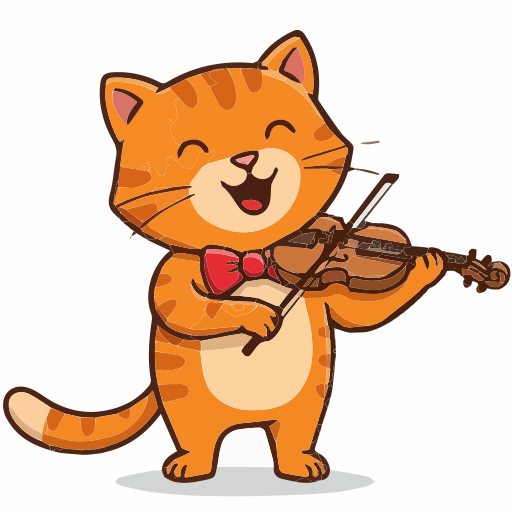

Georgie Porgie


Lyrics
Georgie Porgie, pudding and pie,Kissed the girls and made them cry,When the boys came out to play,Georgie Porgie ran away.
History and Meaning
"Georgie Porgie" is a playground taunt about a boy who is bold with girls and a coward in front of boys. It is one of the few nursery rhymes still used for its original purpose, chanted at children called George, and its four lines have been quietly rewritten over the past two centuries in a way that changed what the rhyme is actually accusing him of.
Origins
The rhyme first reached print in 1841, in a literary miscellany called The Kentish Coronal, where it was presented as a fragment of an "old ballad" and the boy's name was spelled "Georgy Peorgy." It is catalogued as Roud 19532.
The 1841 text runs:
Georgie Porgie, pudding and pie, Kissed the girls and made them cry, When the girls came out to play, Georgie Porgie ran away.
Note the third line. In the earliest version it is the girls who come out to play.
James Halliwell-Phillipps left the rhyme out of his first collection of The Nursery Rhymes of England, then included a variant in the fifth edition of 1853 under a different name: "Rowley Powley, pumpkin pie." By 1884 a version had appeared with "When the boys came out to play," and that is the reading Iona and Peter Opie carried into the Oxford Dictionary of Nursery Rhymes in 1951, which is why it is the one everybody now knows.
The girls-to-boys switch changes the whole rhyme
This is the most interesting thing about "Georgie Porgie" and it usually goes unmentioned.
In the 1841 version, Georgie kisses the girls, makes them cry, and then runs away when the girls come back out. He is fleeing the people he wronged. The rhyme is about a boy who cannot face the consequences of his own behaviour, and the girls are the ones with the power in the final line.
In the modern version, he runs when the boys arrive. The girls drop out of the ending entirely, and the rhyme becomes about male hierarchy: Georgie is a coward who only picks on people he thinks cannot retaliate, and the boys are the ones who scare him off. The wronged party has been replaced by a third party.
Both versions call him a coward. Only the older one holds him accountable to the girls themselves. Nobody appears to have made that edit deliberately; it is the kind of drift that happens when a rhyme lives in playgrounds rather than in books, and it is a good illustration of why the earliest printed text of a rhyme is worth knowing.
Who is the rhyme Georgie Porgie about?
There is no evidence it is about anyone. The rhyme's target is a generic boy, which is what makes it usable as a taunt.
The Opies recorded several conjectures linking Georgie to real figures and were explicit that they were unsubstantiated. The two they mentioned are King George I and George Villiers, 1st Duke of Buckingham, the favourite of James I who was notorious at court for his affairs and was assassinated in 1628. A third claim, attaching the rhyme to King George IV on the strength of his weight and his disastrous marriage, circulates widely and is later still.
All three run into the same wall: the rhyme has no traceable existence before 1841. Villiers died 213 years before that first printing, and no intervening text connects him to the verse. The Opies noted these guesses in order to dismiss them, and as they observed, the guesses were then copied from reference work to reference work until they acquired the appearance of scholarship. They remain guesses.
Does "pudding and pie" refer to King George IV's weight?
Almost certainly not, and Halliwell's 1853 variant is the reason to doubt it.
If "pudding and pie" were a jab at a specific fat king, it would be the fixed, meaningful part of the line. Instead, when the rhyme turns up in 1853 under a different name, the phrase has been freely swapped for "pumpkin pie." Words that carry a coded political meaning do not get casually replaced with other food words. Words that exist to fill a rhythm do.
"Georgie Porgie, pudding and pie" is doing what English taunt rhymes have always done: reduplicating a name into something absurd and then piling on more nonsense. It is the same machinery as "Rowley Powley," or "Jack Sprat," or any playground chant that turns a classmate's name into a jingle.
When was Georgie Porgie first published?
1841, in The Kentish Coronal, where it was described as a fragment of an old ballad and the name appeared as "Georgy Peorgy." The description as an "old ballad" implies the rhyme was already in circulation, but no earlier text has been found, so 1841 is the earliest date the rhyme can be documented.
Meaning
Read for what it is, the rhyme is a piece of social enforcement carried out by children. It names a specific failing, not being unkind to girls exactly, but being unkind and then lacking the nerve to stand behind it. The insult is the cowardice more than the kissing.
That is also why it has survived in active use while most rhymes of its age have become bedtime recital pieces. "Georgie Porgie" has a job. It is sung at someone.
The kissing has aged awkwardly, and modern readers sometimes hear the rhyme as making light of unwanted physical contact. Worth noting that the rhyme is not on Georgie's side. He makes the girls cry, he is named for it, and he runs. Whatever else it is, it is not a rhyme that admires him.
Variants
Rowley Powley (Halliwell, 1853) is the best-documented alternative, opening "Rowley Powley, pumpkin pie." Playgrounds continue to generate their own versions, and the name is routinely swapped for whichever boy is being teased, which is the rhyme working exactly as intended.
Music Video
If the player is unavailable, watch this video on YouTube.
Related Nursery Rhymes




Lyrics from nurseryrhymes.info