

Il est né, le divin Enfant


French Nursery Rhyme
Original Lyrics
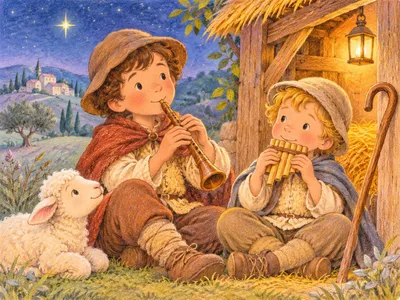
Il est né, le divin Enfant,Jouez, hautbois, résonnez, musettes !Il est né, le divin Enfant,Chantons tous son avènement.
Depuis plus de quatre mille ans,Nous le promettaient les prophètes.Depuis plus de quatre mille ans,Nous attendions cet heureux temps.
English meaning
The divine Child is born,Play, oboes! Ring out, bagpipes!The divine Child is born,Let us all sing of his coming.
For more than four thousand years,The prophets had promised him to us.For more than four thousand years,We had waited for this happy time.
Translation Notes
Translation Notes
The English lines give the meaning of the French words. Here musettes are small bagpipes, and avènement means a long-awaited coming or arrival.
Find more songs in the Christmas nursery rhymes and carols collection.
History and Meaning
This French carol welcomes the Christ child with oboes and bagpipes. The opening verse turns back to the long wait described by the singers. Repeat the refrain after the verse to bring the song back to the celebration.
Where did the tune come from?
Jean-Romary Grosjean printed the melody as an old hunting air in his nineteenth-century collection of Lorraine carols. Gabriel Fauré also arranged the traditional carol for voices and organ. Grosjean's Lorraine carol collection and Fauré's published score.
How do you say the title?
Try eel eh nay luh dee-veen ahn-fahn. Link divin and enfant so that the n leads into the next word. The last syllable of enfant has a nasal vowel and a silent final t. In hautbois, the opening h and the final s are both silent. Try oh-bwah.
Lyrics from nurseryrhymes.info