
Au Clair de la Lune

French Nursery Rhyme
Original Lyrics
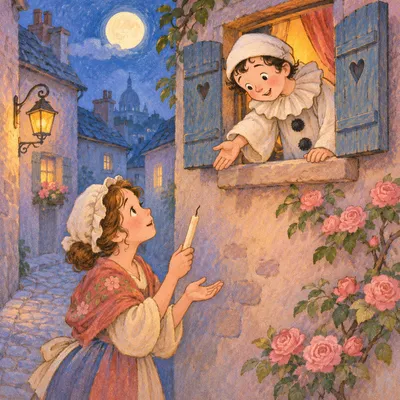
Au clair de la lune,Mon ami Pierrot,Prête-moi ta plumePour écrire un mot.Ma chandelle est morte,Je n’ai plus de feu ;Ouvre-moi ta porte,Pour l’amour de Dieu.
Au clair de la lune,Pierrot répondit :Je n’ai pas de plume ;Je suis dans mon lit.Va chez la voisine ;Je crois qu’elle y est,Car dans sa cuisineOn bat le briquet.
English Translation
By the light of the moon,My friend Pierrot,Lend me your quillTo write a note.My candle has gone out,I have no fire left;Open your door for me,For the love of God.
By the light of the moon,Pierrot replied:I don't have a quill;I'm in my bed.Go to the neighbour's;I think she's there,Because in her kitchenSomeone is striking a light.
History and Meaning
“Au Clair de la Lune” is a French children's song that begins with a knock at night. A visitor asks Pierrot for a quill and a light. Pierrot is already in bed, so he sends the visitor next door, where he can hear someone trying to light a fire. The children's song is distinct from Debussy's piano piece Clair de lune.
How do you pronounce Au Clair de la Lune?
Say au clair roughly as oh klehr. In lune, make the vowel by saying ee while rounding your lips. Pierrot is roughly pyeh-ROH, with a silent final t.
Plume means feather, or a quill pen in this setting. Chandelle is a candle, and ma chandelle est morte literally calls it “dead”: it has gone out. Battre le briquet refers to striking sparks with a fire steel, the sound that tells Pierrot the neighbour is awake.
Why do some versions have more verses?
The first two verses here follow Chansons populaires de France (1865). In that collection two more verses name the visitor as Lubin and take him to the neighbour's door. Weckerlin's 1870 collection also notes that different verses were sung to the air. The request, the reply and the neighbour's kitchen form a scene even when the singer stops after two verses.
Lyrics from nurseryrhymes.info